
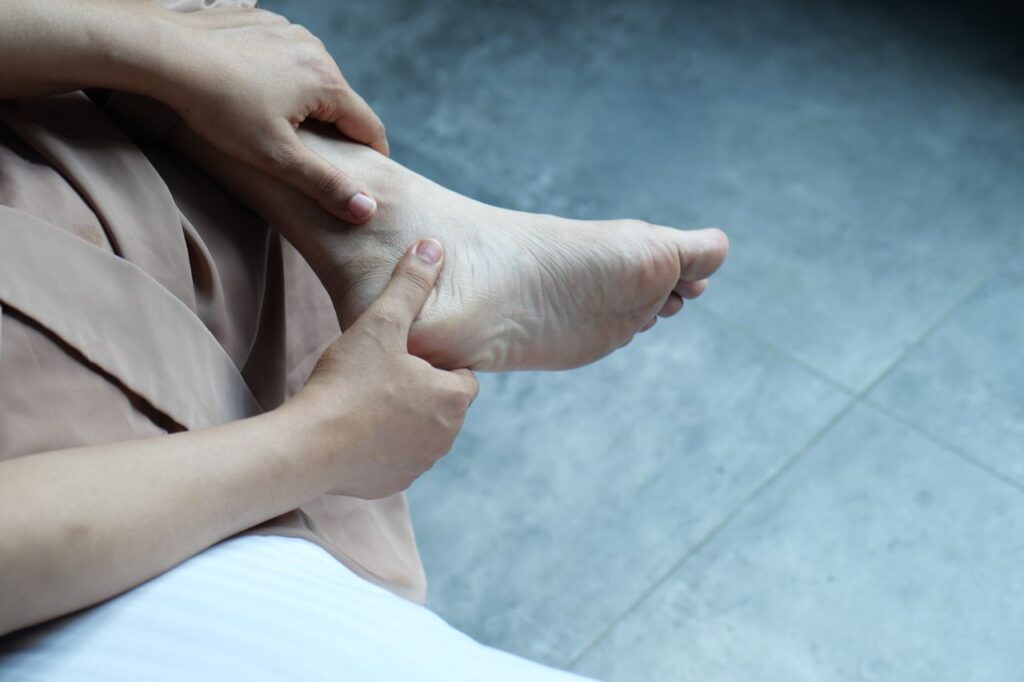
That nagging ache under your heel or burning discomfort across the ball of your foot can have many possible causes. In some cases, recurring foot pain may be associated with biomechanical factors, such as changes in foot motion, load distribution, muscle function, footwear, or the way you move during everyday activities. However, foot pain does not automatically mean you have a larger biomechanical problem.
Your feet work together with your ankles, knees, hips, and other structures during movement. Changes in foot mechanics can influence movement elsewhere in the lower limb, although the relationship varies from person to person. When foot pain keeps returning, affects the way you walk, or appears alongside other movement changes, looking at your foot mechanics can provide useful information about factors that may be contributing to your symptoms.
Key Takeaways
- Persistent or recurring foot pain can sometimes be associated with altered foot or lower-limb mechanics, although many other causes are possible.
- Differences in pronation, arch structure, foot stiffness, strength, and movement control may influence how your feet manage load during activity.
- Uneven shoe wear, recurring ankle sprains, or changes in the way you walk can provide useful information during a foot or gait assessment.
- Gait analysis and 3D foot mapping can help identify movement, pressure, and structural characteristics that may be relevant to your symptoms.
- Custom orthotics, strengthening, mobility work, and footwear changes may be considered based on your individual assessment findings and functional needs.
Why Foot Pain Signals Bigger Biomechanical Problems
Your feet experience substantial forces during everyday movement, and the amount of loading varies depending on whether you are walking, running, jumping, standing, or performing another activity. Repeated loading can make foot mechanics relevant when you experience persistent or recurring symptoms. Differences in foot motion or stiffness may also influence how forces are distributed through the foot and lower limb, although the effect varies from person to person.
The Kinetic Chain Connection
Your feet form an important part of the lower-limb kinetic chain, working with the ankle, knee, hip, and pelvis during movement. Changes in foot motion can influence movement at other joints, but the relationship is not automatic or identical for everyone. Factors such as strength, joint mobility, previous injury, activity level, and individual anatomy can also affect how you move.
How Misalignment Travels Upward
Changes in foot and arch motion can be associated with differences in tibial and lower-limb movement during weight bearing. In some people, these changes may influence mechanics farther up the lower limb, including movement at the knee or hip. However, this does not mean that a particular foot position directly causes pain or dysfunction elsewhere. Your overall movement pattern and symptoms need to be considered together.
Gait Compensation and Secondary Strain
Pain can change the way you walk, sometimes without you consciously noticing it. For example, you may reduce pressure on a painful area, shorten your stride, change your push-off, or shift your weight to another part of the foot. These adaptations can change how forces are distributed across the lower limb. If the altered pattern continues, it may be useful to assess whether the original pain, the compensation, or another factor is contributing to your symptoms.
What Biomechanical Factors May Contribute to Foot Pain
Not all foot pain has the same cause, which is why treatment should be based on your symptoms and individual assessment rather than assuming that one approach will work for everyone.
Overpronation and Flat Arches
Pronation is a normal part of walking. Your foot naturally changes position as it accepts weight and adapts to the ground. Some people pronate more than others without experiencing pain or functional problems.
Greater or poorly controlled pronation may become relevant when it occurs alongside symptoms, instability, or changes in movement. Low arches or flexible arches may also change how your foot handles load during weight-bearing activities. These characteristics can be considered during an assessment, but they should not automatically be treated as the cause of foot pain.
Conditions such as plantar heel pain and posterior tibial tendon problems can involve multiple contributing factors, including activity demands, tissue capacity, strength, mobility, and foot mechanics. A proper assessment helps determine which factors may be relevant to you.
Supination and Rigid Feet
A rigid or high-arched foot may have different load-management characteristics from a more flexible foot. Because the foot may have less ability to adapt to the ground, pressure can be distributed differently during weight-bearing activities. In some people, this may be relevant to discomfort involving the heel, forefoot, or lateral foot.
However, a high arch or supinated foot does not automatically cause pain. Symptoms such as stress injuries or recurrent ankle problems have multiple possible causes, so your foot structure should be considered alongside your activity level, injury history, footwear, strength, and movement pattern.
Muscle Weakness and Joint Instability
Foot shape is only one part of biomechanics. Muscle strength and movement control can also influence how your feet and lower limbs function during activity. Reduced intrinsic foot muscle strength may affect active control of foot movement and stability, while weakness or reduced control elsewhere in the lower limb may influence how you move during weight bearing.
Strengthening should therefore be individualized rather than based on the assumption that everyone with foot pain needs the same exercises. An assessment can help identify whether strength, mobility, balance, or movement control appears relevant to your symptoms.
What Warning Signs Point to a Deeper Issue
Persistent or recurring foot pain deserves attention, particularly when it affects the way you walk, limits your usual activities, or occurs alongside changes in stability or movement. Certain patterns may provide useful information during a foot or gait assessment.
- Persistent or recurring pain: Foot pain that continues, repeatedly returns, or begins affecting your walking and daily activities deserves further evaluation.
- Uneven shoe wear: Differences in shoe wear may provide clues about how you load your feet, although shoe wear alone cannot diagnose a biomechanical problem.
- Changes in stability or movement: Repeated ankle sprains, a feeling of instability, or noticeable changes in your walking pattern may be useful information to discuss during an assessment.
None of these findings proves that biomechanics are responsible for your pain. They are simply reasons to look more closely at the overall pattern rather than focusing only on the location of the discomfort.
How Gait Analysis Can Identify Relevant Movement Patterns
Guessing at the cause of foot pain rarely works, mostly because two people with identical symptoms can have entirely different underlying mechanics. This is where a proper biomechanics assessment earns its keep.
3D Foot Mapping and Pressure Testing
3D foot mapping can capture detailed information about the shape and contours of your feet. When pressure assessment is available, it can provide additional information about how load is distributed beneath your feet during standing or movement.
These tools can add useful information to a broader assessment, but they do not independently identify the cause of every foot problem. Your symptoms, foot structure, movement pattern, activity demands, footwear, and relevant medical history should all be considered when interpreting the findings.
Video-Based Movement Assessment
Video-based gait assessment can provide additional information about how your feet and lower limbs move during walking or running. It may help an assessor observe characteristics such as foot and ankle motion, step pattern, symmetry, and movement during different phases of gait.
Video analysis is most useful when interpreted alongside your symptoms and other assessment findings. It can help identify movement patterns that may be relevant to your symptoms, but it should not be used on its own to determine the cause of foot pain.
Interpreting Your Gait Findings
There is no single set of measurements that defines a normal walking pattern for everyone. Age, walking speed, footwear, anatomy, activity level, and the measurement system can all influence gait findings.
For that reason, your results should be interpreted in context rather than compared with a rigid set of numbers. The more useful question is whether a particular movement or loading pattern is relevant to your symptoms, functional goals, or ability to perform your usual activities.
What Treatment Options May Support Your Foot Mechanics
Custom Orthotics and Support
Custom orthotics can be designed around your individual foot characteristics and functional needs. Depending on their design, they may provide support, influence pressure distribution, or modify aspects of foot mechanics during weight-bearing activities. Whether they are appropriate depends on your symptoms, assessment findings, activities, footwear, and treatment goals.
Targeted Strengthening and Mobility Work
Orthotics are only one potential part of a broader approach. Depending on your assessment findings, strengthening, mobility exercises, balance work, activity modification, or footwear changes may also be appropriate.
The exercises you use should reflect your individual needs. Someone with reduced foot strength may require a different approach from someone whose primary issue involves mobility, balance, or activity-related overload. A qualified professional can help determine which factors are relevant to your movement and symptoms.
When Footwear Changes Are Not Enough
Footwear can influence comfort, stability, and the way your feet interact with the ground. A suitable shoe may be helpful, but changing shoes does not necessarily address every factor contributing to persistent foot pain.
If your symptoms continue despite appropriate footwear, an assessment can help determine whether other factors, such as activity demands, strength, mobility, foot mechanics, or an underlying condition, should be considered.
What Else Can Contribute to Persistent Foot Pain?
Changes in Activity Can Increase Foot Loading
A change in your usual activity level can sometimes contribute to foot discomfort, even when your underlying foot structure has not changed. Increasing your walking distance, running volume, exercise intensity, or time spent standing can increase the demands placed on your feet. This is especially relevant when a change happens quickly, and your body has not had enough time to adapt to the new workload.
For example, you may notice foot discomfort after starting a new exercise routine, taking longer walks, or spending more hours on your feet at work. This does not necessarily mean that your gait is abnormal. The amount, frequency, and type of activity can all influence how much stress is placed on the tissues of your feet.
When evaluating recurring foot pain, it can therefore be helpful to consider what changed around the time your symptoms began. An assessment that looks at both your movement mechanics and your activity demands can provide a more complete picture of the factors that may be contributing to your symptoms.
Previous Injuries Can Affect How You Move
A previous foot or ankle injury can sometimes influence movement even after the original pain has improved. An ankle sprain, for example, may be followed by changes in strength, balance, joint mobility, or confidence when placing weight on the affected side. Some people may unconsciously adjust their walking pattern to avoid discomfort or instability.
These changes do not necessarily mean that an old injury is responsible for current foot pain. However, your injury history can provide useful context during an assessment. If you have experienced repeated ankle sprains, a previous fracture, or another significant lower-limb injury, mentioning it can help a qualified professional consider whether strength, mobility, balance, or movement patterns may be relevant to your current symptoms.
Looking at the history of your symptoms is also important. Knowing when the pain began, what activities make it worse, what makes it better, and whether it has changed over time can help distinguish between different possible contributors.
Your Daily Demands Matter
Your feet respond to the demands you place on them throughout the day. Someone who spends several hours standing or walking at work may experience different loading demands from someone who is mostly seated and exercises for a shorter period each day. The same footwear or activity may also affect two people differently because their strength, mobility, body structure, and activity levels are not identical.
This is why foot pain should be considered in the context of your daily routine rather than viewed only through a static examination. Your work activities, exercise habits, footwear, walking surfaces, and recreational activities can all provide relevant information.
A comprehensive assessment can bring these factors together with your foot structure and movement patterns. Rather than assuming that one factor is responsible, the goal is to identify which factors may be contributing to your symptoms and determine whether changes in activity, footwear, exercise, orthotic support, or further evaluation may be appropriate.
When Should You See a Specialist for Foot Pain
Persistent or recurring foot pain, pain that changes the way you walk, or a feeling of instability during everyday activities are reasonable reasons to seek an evaluation. Repeated ankle sprains are also worth discussing with a qualified healthcare professional because ongoing instability can have several contributing factors.
Depending on your symptoms, an appropriate professional can evaluate your foot structure, movement, strength, footwear, activity demands, and medical history. The goal is to determine which factors may be contributing to your symptoms and whether gait assessment, orthotic support, exercise, footwear changes, or further medical evaluation may be appropriate.
Conclusion
Foot pain can sometimes provide a reason to look more closely at your biomechanics, particularly when symptoms persist, return repeatedly, or affect the way you move. But pain does not automatically mean that your foot mechanics are the underlying cause. Activity demands, footwear, strength, mobility, previous injuries, and medical conditions can all play a role.
A gait and foot assessment can help put those factors into context. Gait analysis can provide information about movement patterns, while 3D foot mapping and other assessment tools can add information about foot structure and loading. If the findings indicate that additional support may be appropriate, custom orthotics can be considered as part of an individualized approach.
The goal is not to force every foot into the same alignment. It is to understand your individual movement pattern and determine what, if anything, may help you move more comfortably and confidently.
Frequently Asked Questions
1. Can foot pain really be related to biomechanical problems?
Foot pain can sometimes be associated with changes in foot mechanics, movement patterns, loading, strength, or mobility. However, foot pain has many possible causes, so a biomechanical assessment is not appropriate as an explanation for every case.
2. How do I know if my foot pain may involve biomechanics?
Recurring pain, changes in the way you walk, feelings of instability, or symptoms that appear consistently during particular activities may justify a closer look at your movement mechanics. These signs do not prove that biomechanics are the cause, but they can provide useful information during an assessment.
3. Is overpronation always a problem?
No. Pronation is a normal part of walking, and people naturally differ in how much they pronate. Greater pronation is more relevant when it occurs alongside symptoms, functional limitations, or other movement concerns.
4. Can foot pain affect the way you walk?
Yes. Pain can cause you to change your stride, push-off, weight distribution, or walking speed. These changes may alter how forces are distributed through the foot and lower limb. Identifying and addressing the source of the pain is important rather than assuming the altered gait itself is the primary problem.
5. What does a foot biomechanics assessment involve?
An assessment may consider your symptoms, foot structure, movement, strength, mobility, footwear, and activity demands. Depending on the services available, gait analysis, 3D foot mapping, or pressure assessment may provide additional information about your individual mechanics.
6. Can 3D foot mapping help with custom orthotics?
3D foot mapping can provide detailed information about the shape and contours of your feet. When combined with other assessment findings, it may help inform decisions about individualized foot support and custom orthotic design.
7. Are custom orthotics appropriate for everyone with foot pain?
No. Custom orthotics are not appropriate for every type or cause of foot pain. Their suitability depends on your symptoms, assessment findings, activities, footwear, and treatment goals. A personalized evaluation can help determine whether orthotic support is appropriate for you.